


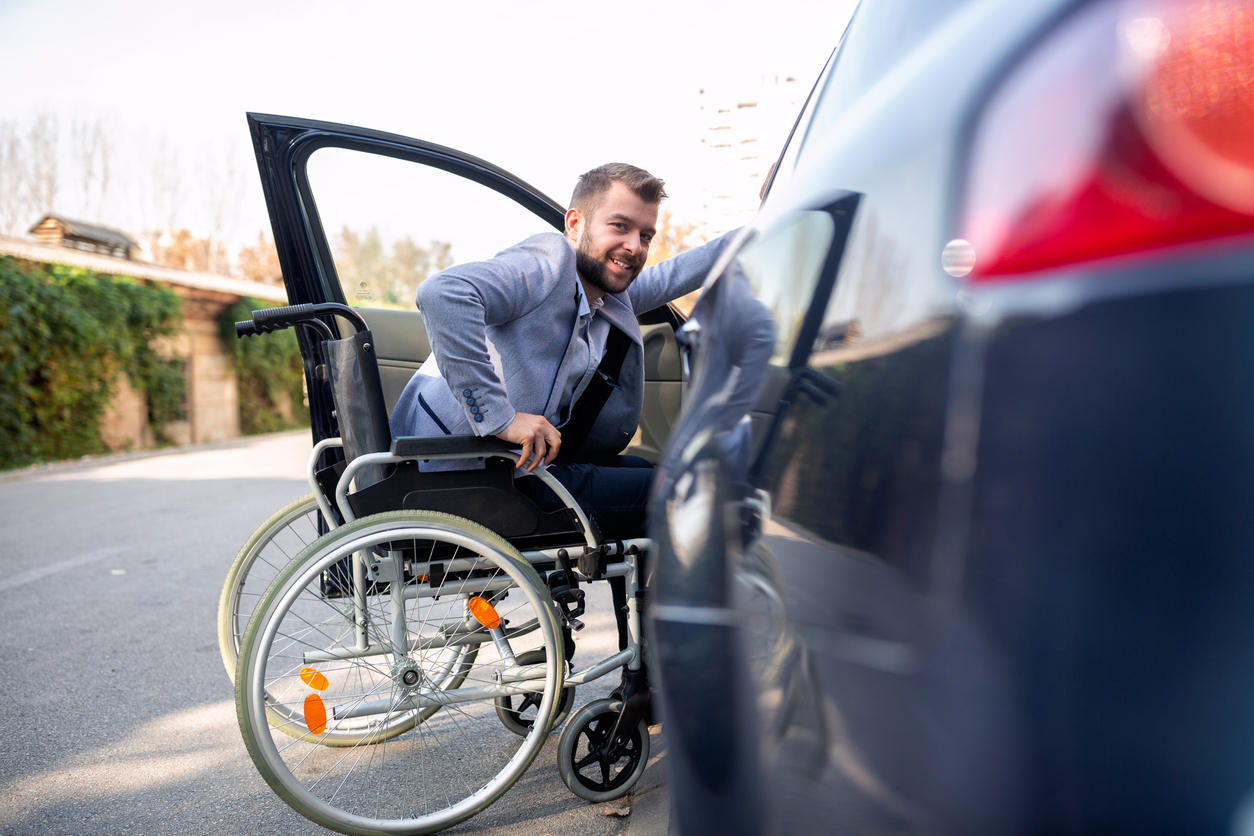
March is Disability Awareness Month! If you’re an able bodied person, chances are you may not have thought about how modern day to day activities may not be accessible to folks with disabilities or health concerns. Today we’re going to shed some light on the subject, such as various accessibility needs to improve on roadways, adapting vehicles, accessible public transport, and related topics.

Let’s Talk About Disability!
Did you know that WHO has estimated that more than 1 billion people are experiencing significant disability on a global scale? That means that about 16% of the world’s population, or 1 in every 6 people, experiences some form of disabling condition. In the United States alone, that number increased to 26%, meaning 1 in 4 people has a disability (2022 Bureau of Labor Statistics.) Decreased mobility is one of the most common disabilities, along with motor impairments.
Let’s learn about disability, terminology, representation, and accessibility from the disability community:
What about accessibility in transportation?

For drivers with disabilities, special vehicle modifications can be made to your already existing vehicle, but in some cases a vehicle may need to be more heavily modified and tailor made to the specific needs of someone with mobility aids. These adaptive technologies allow disabled drivers and passengers to access their vehicle and be independent of rideshares, transport, or caregivers/chauffeurs. Adaptive equipment can include modified hand controls to help steer and operate the vehicle or enable turn/brake signals (push-pull, knobs, spinners, etc.); foot control modifications to the accelerator and brake pedal; assistive support straps and/or rings to assist entering and exiting a vehicle; specialized doors and hatchbacks; seat belt modifications for mobility, posture, and size; ramps or lifts for wheelchair users, and seat modifications for mobility issues and transferring from wheelchairs.

Drivers may also attend special Driver Rehabilitation Training to learn how to use their adaptive devices, or how to drive/steer/operate a vehicle with a different limb than is typical of abled drivers. You may explore more details around each very specific need and purpose for these adaptations via this fabulous guide, as well as other pertinent info on driver rehabilitation, adaptive driving evaluations, and what vehicle makes/models are most accommodating to adapting!

When it comes to navigating streets and roadways as a disabled pedestrian, there are a number of things to consider when it comes to road traffic safety in our vehicle-centric world. “Complete Streets” policies are a series of accessibliity needs that should be met in order to afford the most access to disabled citizens and travelers. These concepts include increased pedestrian infrastructures such as sidewalks, crosswalks, accessible signals for visually impaired people, median crossing islands; traffic management in the form of speed humps, speed tables, clear signage, traffic lights and blinking signals; clear and dedicated bike lanes and bike parking; dedicated bus lanes, accessible bus shelters, etc.

Many roadways and sidewalks are inaccessible to pedestrians, requiring them to be in harm’s way and increasing risk that vehicles may have collisions. Things such as inadequate sidewalks; broken, unpaved, or cracked sidwealks and pavement; lack of curb cutouts or ramps or texture on corners for visually impaired individuals; sidewalk obstacles (think outdoor dining blocking wheelchair or mobility device access); bench obstacles and lack of seating while waiting for rideshares or public transportation; push buttons for traffic lights and cross signals being at wheelchair accessible heights; verbal and audible signals for safe crossing or traffic lights for visibly impaired pedestrians.

Transportation and mobility accessibility are important civil rights issues for disabled and able bodied individuals; by increasing access to safe, affordable, and reliable transportation we create equity and equal opportunity for everyone! By creating more accessible cities, increasing accessibility to public transportation and mass transit, and safer waiting areas for rideshare users, we can improve the experience and accessibility for disabled drivers and pedestrians.
Here are some great examples of adaptive controls and accessibility in action:
Talking about disability with kids and teens:
![[Facebook]](https://www.classickiaonline.com/blogs/294/wp-content/plugins/bookmarkify/facebook.png)
![[LinkedIn]](https://www.classickiaonline.com/blogs/294/wp-content/plugins/bookmarkify/linkedin.png)
![[Twitter]](https://www.classickiaonline.com/blogs/294/wp-content/plugins/bookmarkify/twitter.png)
![[Yahoo!]](https://www.classickiaonline.com/blogs/294/wp-content/plugins/bookmarkify/yahoo.png)
![[Email]](https://www.classickiaonline.com/blogs/294/wp-content/plugins/bookmarkify/email.png)


 Warranties include 10-year/100,000-mile powertrain and 5-year/60,000-mile basic. All warranties and roadside assistance are limited. See retailer for warranty details.