


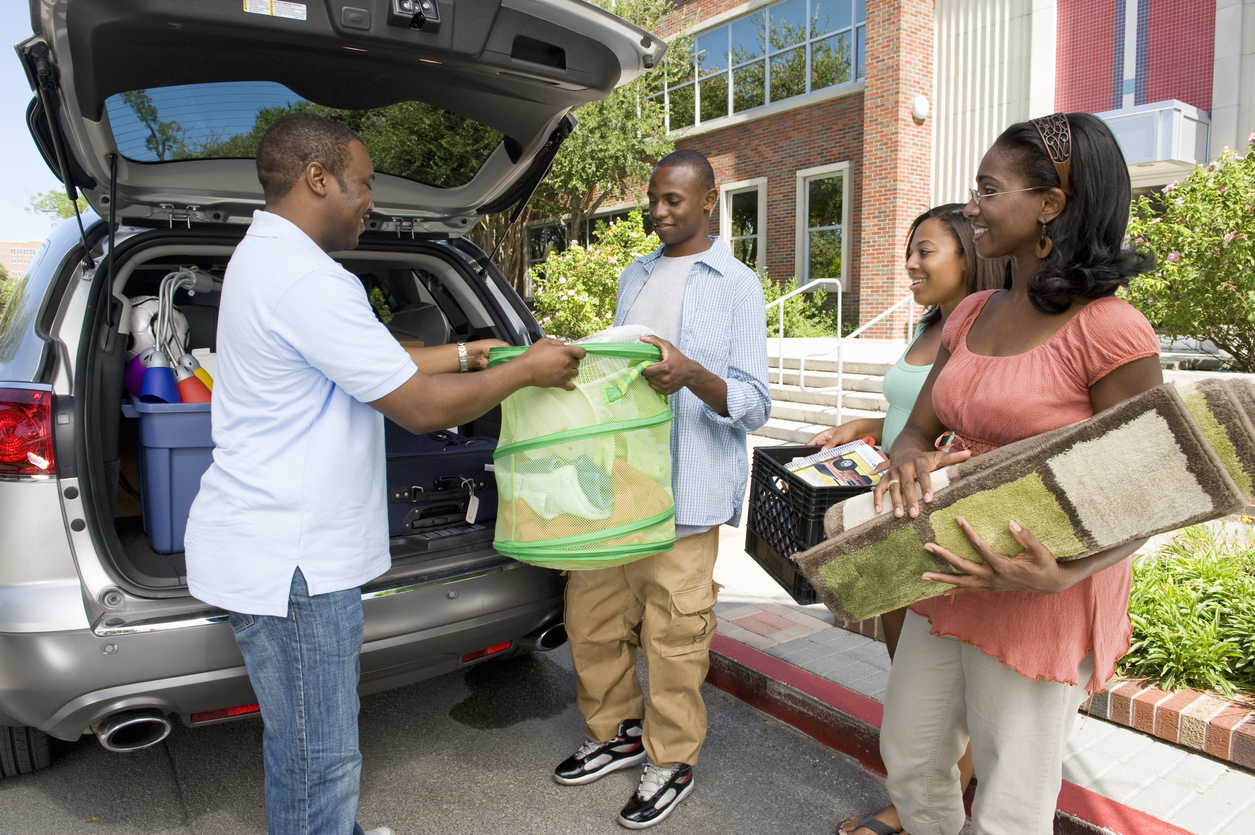
Summer is winding down. Back to School energy is in full swing! And we’re here to help ease the transition from high school to college with this handy guide for inbound college students. Let us help you take the stress out of packing your car as you embark on your journey from home to school, either for the first time or a return to your dorm/apartment. There’s always room to improve your packing skills and learn something new! So let’s get started so you can get on the road to independence faster.

If you’ve got a tip that can help incoming students learn what they do and don’t need for their college experience, feel free to drop us a line in the comments on our social media to share your thoughts! We’d love to hear from our clients and customers on what worked best for you and your students.
Tip #1: Label your boxes, bags, and baskets and write up an inventory list!
Packing lists aren’t just for moving houses and apartments, but they can also be a great tool for organizing your belongings on road trips and for school travel. Sit down and create a list of items you’ll need to bring, and organize them into categories such as “Bedroom”, “Clothing”, “Study Gear”, “Electronics”, “Kitchen”, etc. Group similar items together and assign them a color code and/or number to make it easier for you to unload and unpack when you arrive at your housing or dorm. This will also make it easier to determine where in the vehicle your items will go, with heavier items placed at the bottom and lighter items on the top, or cargo space versus trailer versus roof rack!

Tip #2: Learn the limits of your vehicle’s tow capacity as well as interior weight limits for transporting passengers/cargo!
It’s tempting to try to cram as much as you can into the hatchback of your SUV or hybrid, or to jam pack your truck or van’s cargo space to the end of its limits. But did you know that meeting or exceeding that weight limit can cause irreparable damage to your car as well as your goods? You can greatly affect your vehicle’s handling, fuel efficiency, steering, and tires if you overload the weight capacity. Check the load capacity in your owners’ manual to make sure you don’t over stuff it! If you’ve got towing options or a roof rack, remember to factor that in as well. And, of course, before you hit the road, give your tire pressure a check to make sure the air pressure hasn’t changed and adjust as needed.

Tip #3: Pack efficiently and leave non-essential items behind.
While it’s tempting to stuff your luggage and pack for every single scenario and season, you’ll save a lot of time, energy, money, and fuel if you pack efficiently. Consider the seasons and weather conditions for your college town, and pack appropriately. If you’ll be coming home between semesters or on holidays, consider packing seasonal wardrobes that you can swap out on your visits home instead of lugging 365 days and 4 seasons worth. College schedules don’t just include studying, tests, and papers but also social events, parties, day trips, and more, so make sure you’re only taking items with you that you’ll use in your down time. It can be tempting to haul suitcases worth of books, games, and other entertainment with you, but be realistic about how much time you’ll be spending using those extraneous items you’re hankering to take with you.

Tip #4: Secure your cargo in baskets, bins, and bags, and use cargo anchors or straps to avoid piling up loose items, but remember to leave room for clear visibility!
Make sure that all of your belongings are safely stowed and secured with little to no chance of movement. Before you hit the road, you should give it some due diligence to ensure that everything is tightly secured down so it shifts as little as possible during your journey. In the event that you need to stop short, heavy loads may shift or come loose and could impair your vision or even become dangerous projectiles in an accident. Don’t block windows or pile loose things over the height of your rear seat. Be mindful as well that anything blocking or covering up your views of any mirrors or rear windows may be considered an “Obstruction of View” and lead to a traffic ticket!
Tip #5: Keep your essential items within reach for easy access and emergencies.
Make sure that items such as your first aid kit, fire extinguisher, emergency car kit, flashlight, and other essentials are within easy reach at a moment’s notice. Make sure that your charging cables are organized neatly in the center console or other accessible area so you’re not fiddling for items while on the road.
![[Facebook]](https://www.classickiaonline.com/blogs/294/wp-content/plugins/bookmarkify/facebook.png)
![[LinkedIn]](https://www.classickiaonline.com/blogs/294/wp-content/plugins/bookmarkify/linkedin.png)
![[Twitter]](https://www.classickiaonline.com/blogs/294/wp-content/plugins/bookmarkify/twitter.png)
![[Yahoo!]](https://www.classickiaonline.com/blogs/294/wp-content/plugins/bookmarkify/yahoo.png)
![[Email]](https://www.classickiaonline.com/blogs/294/wp-content/plugins/bookmarkify/email.png)
Connect with us


- 2026 Kia Sportage Performance and Features for Illinois Drivers
- Top 5 Features of the 2026 Kia Sportage Hybrid
- A First Look at the 2027 Kia Telluride
- Celebrate the Holidays by Gifting a Road Trip to the Michigan Ice Fest 2026!
- Extending the Spirit of The Giving Season: Great Ways to Give Back to the Community For the Holidays (Lake County, Waukegan Area)
Recent Posts
 Warranties include 10-year/100,000-mile powertrain and 5-year/60,000-mile basic. All warranties and roadside assistance are limited. See retailer for warranty details.