


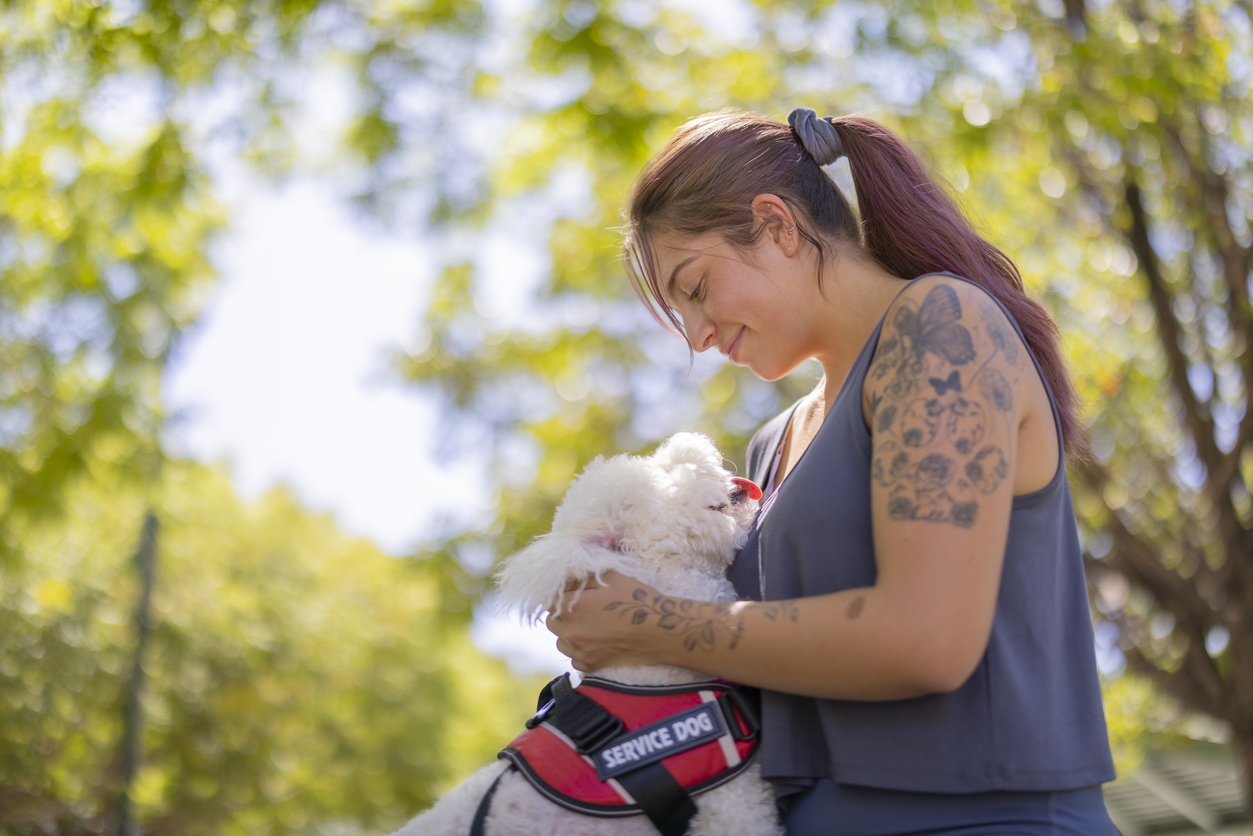
Today is National Assistance Dog Day, celebrating the many tasks and jobs that hardworking pups do across the globe as service animals to their handlers! Let’s take a look at some of the dos-and-don’ts, ins-and-outs surrounding the different things you need to know about Service Dogs and Assistance Dogs including how they travel and use public transportation.

What is a task trained Service Dog versus an Emotional Support Animal?
A service dog is task-trained to provide assistance and/or mitigate a person’s disabilities. They have been individually trained to perform a task such as retrieve, alert, mobility assistance, etc. Service Animals require a specific temperament and personality, and are federally protected working animals. The work or task they perform must be specifically related to the handler’s disability. This includes Guide Dogs/Seeing Eye Dogs, Hearing or Signal Dogs, Psychiatric Service Dogs, Sensory/Social Signal Dogs, Medical/Seizure Response Dogs, and similar Alert Dogs. A persons disability may be visibly apparent, or may be considered an “invisible disability or invisible illness” meaning signs may not be overtly obvious; service teams of all kinds are valid, regardless.
There are no limitations to size or breed of service animals, so you may see the typical options (Labradors, Golden Retrievers, Goldendoodles, German Shepherds) or you may see more unconventional breeds such as Chihuahuas, Yorkies, or mixed breed rescue/shelter animals!
A doctor’s note or letter does not certify animals as a service animal, rather they have been through a rigorous program of obedience and behavior management and explicitly specific task training classes. Service animals are not required to be labeled or vested, though many handlers do opt to do so for easy travel and to help the public understand not to interact with these task-trained animals.

There is some confusion between the designation of An Emotional Support Animal (ESA) versus a Task Trained Working Service Dog. An Emotional Support Animal (ESA) is not the same nor equal to a service animal. In contrast to a task-trained Service Animal, ESAs merely provide comfort and emotional reassurance, but have not been trained to perform any specific tasks or behaviors to assist an individual’s disability. ESAs are not afforded the same public access rights, although a medically certified ESA may be allowed to override “no pet” policies in housing and lodging. You cannot bring your ESA into public areas that are not specifically designated as Pet Friendly.
Specially trained and task-oriented Service Animals are considered as vital to a disabled person’s functionality as any other mobility aid or medical device, and thus will be allowed into most spaces where your pet or an ESA may not be permitted. Falsely labeling your animal as a service animal can cause serious harm or injury to working animals. Bringing your Pet or an ESA into unpermitted public places can interfere with working Service Dog Teams and cause issues. Please be respectful and mindful of these parameters and policies so you can continue to help keep Service teams safe!
Many service dogs perform life-saving tasks, and interfering with or distracting these animals can mean the difference between safety and injury or death of the handler. Let’s all do our part to learn the etiquette of being a member of the public within the vicinity of a working team.

If you see a service animal in a public environment or on public transportation, here are some do’s-and-don’t’s:
Do not approach or distract the animal; if you have a question, approach the handler only. We love dogs as much as the next person, but it’s important to know this is not your average dog, but it’s not appropriate to make kissy noises, whistles, or other physical or verbal cues to get a Service Dog’s attention. You may approach the handler respectfully if you have questions, but please be aware they may not be able to respond to you or may not wish to answer questions. A resting or sleeping service dog is still on duty.
Assume that every dog you meet is a working canine, and never touch a service dog without permission first. Likewise, do not allow your dog to walk up to other dogs without asking permission or speaking to the handler to verify. Service dogs may not be vested or tagged at all times, and it is not a requirement of ADA regulations that they do so. Be mindful of interactions with dogs in public and always ask a handler if it is safe to pet or approach the animal. It may be someone’s mobility aid or medical device! Allowing other dogs to interact without permission can cause irreparable damage to this working team.
Don’t judge. Service dogs undergo an average of 2 years worth of training before they’re fit for the job, and it requires rigorous training and public access tests. If you see a working dog in an unexpected place such as a food establishment or public transportation, they’re allowed to be there and the establishment will handle it. Although service dogs are trained for public access, they’re still dogs and may have days off the same as you and me even if they’re doing their best! You do not need to interfere with the handler by correcting the animal; the handler will take necessary steps.
An Unattended Service Dog is a sign that its handler needs help. If you see a service dog wandering around without its handler and it approaches you, follow the dog and it will lead you to its owner. You can identify the handler, assess the situation, check for medical info, and call 9-1-1 if needed. A service dog may nudge, paw, or bark at you to alert you to an emergency situation.

How do Service Dog Teams Travel safely in cars and on public transport?
- Chartered car services and public transportation may not refuse service to a passenger due to the presence of a task-trained working service dog; service animals must be allowed public access same as the owner, even on ride share services such as Uber or Lyft or private taxi/limo.
- Service dogs will usually be trained with a catchphrase for loading and unloading into the vehicle, and must sit quietly after doing so. They should not be allowed to roam from front to back. They should remain calm and quiet when someone approaches the vehicle
- Secure your service dog with a car harness and short tether. Special seatbelts and tethers can be purchased for your dog that click into seat belt attachments and keep your dog secured to the vehicle backseat or inside their car seat in the event of an accident.
- Secure your service dog with a car harness and long tether. A long tether allows your canine to sit securely in theri car seat or a vehicle backseat, or to lay down on the floor beneath your feet safely.
- Use a travel kennel to secure your service dog. Special hard-case plastic or metal travel kennels are a great way to secure and protect your service dog while traveling. Tether the kennel to the vehicle’s cargo area or back seat to prevent jostling or being tossed around in event of an accident.
![[Facebook]](https://www.classickiaonline.com/blogs/294/wp-content/plugins/bookmarkify/facebook.png)
![[LinkedIn]](https://www.classickiaonline.com/blogs/294/wp-content/plugins/bookmarkify/linkedin.png)
![[Twitter]](https://www.classickiaonline.com/blogs/294/wp-content/plugins/bookmarkify/twitter.png)
![[Yahoo!]](https://www.classickiaonline.com/blogs/294/wp-content/plugins/bookmarkify/yahoo.png)
![[Email]](https://www.classickiaonline.com/blogs/294/wp-content/plugins/bookmarkify/email.png)
Connect with us


- 2026 Kia Sportage Performance and Features for Illinois Drivers
- Top 5 Features of the 2026 Kia Sportage Hybrid
- A First Look at the 2027 Kia Telluride
- Celebrate the Holidays by Gifting a Road Trip to the Michigan Ice Fest 2026!
- Extending the Spirit of The Giving Season: Great Ways to Give Back to the Community For the Holidays (Lake County, Waukegan Area)
Recent Posts
 Warranties include 10-year/100,000-mile powertrain and 5-year/60,000-mile basic. All warranties and roadside assistance are limited. See retailer for warranty details.