


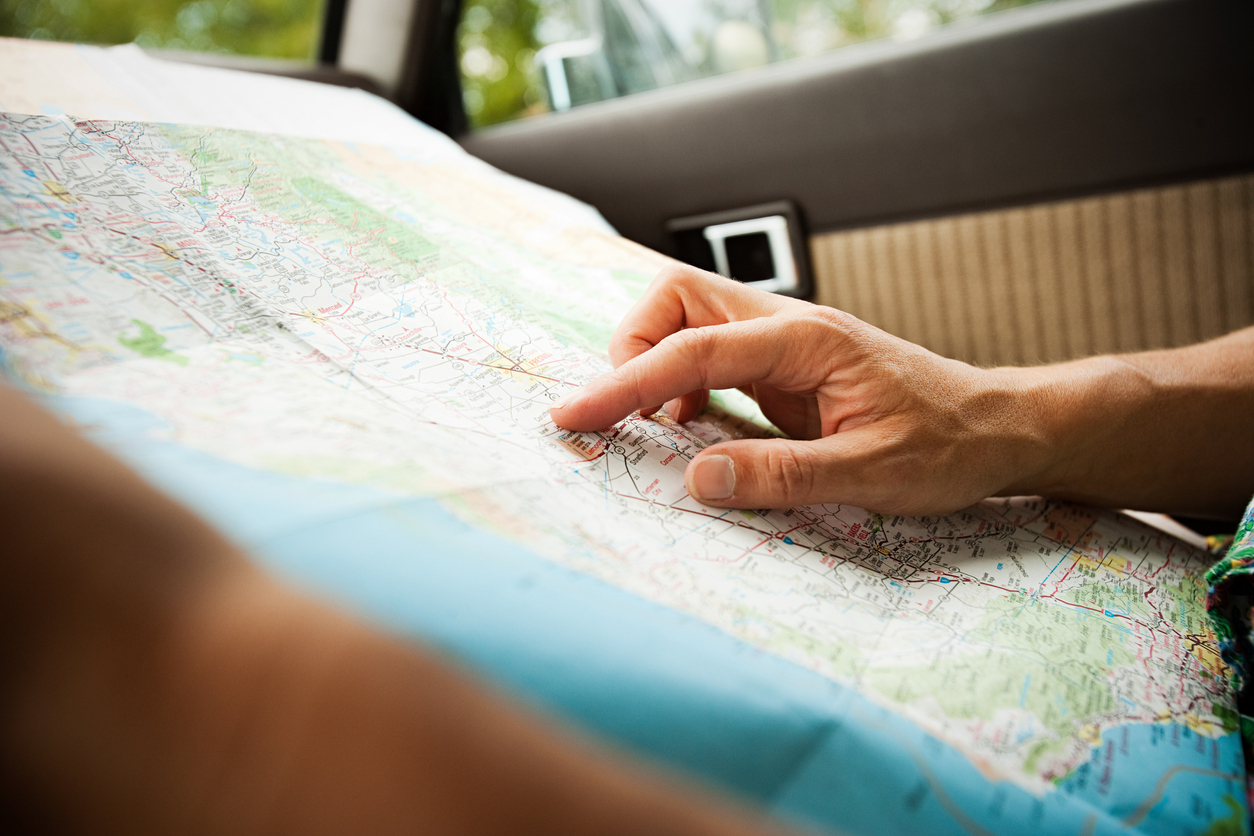
It’s National Read a Road Map Day! In the age of smartphones and infotainment navigation we’re hedging our bets that reading a map is a skill that most of us could use a refresher on. We love the convenience and reliability of modern technology for navigation, but it never hurts to know how to “read an offline map” so to speak.

Understanding the symbols, layout, and terms surrounding road maps can help get you back on the road in the event you are driving in an area with low reception, are enjoying an off-roading adventure, or perhaps even have a technological malfunction while on an adventure.

Today we’re going to give you some pointers on making heads or tails of a map and how to read it with ease!
Helpful Tips to Learn How to Read a Road Map
- Make sure that you can find north on your map. This is usually denoted by the “N” symbol on your compass rose, but in the event your map does not have one, generally it is safe to assume the top edge of the map is considered “North” direction.
- Your map will be divided up in a grid format with vertical lines being indicated by numbered columns, and horizontal lines indicated by numbered rows. You will use these numbered and lettered designations to zero in on locations of important places noted on your Map’s index.
- Find the Map Key or Map Legend or Index. This will generally be on the back of your map or sometimes located in the corners. It will break down driving distance, specific topographic features, and decode the icons.
- Map icons will be defined in the map legend or key. This will help you identify locations of landmarks, buildings, rivers, mountains, forests, and other structures. As an example, some areas may be colored in green to signify forest coverage, rivers may be solid blue lines, etc. On other maps, you may see various shading to indicate the type of terrain: mountains, sand and shoreline, forest, grassy plains, etc. The key will be different on each map, though many maps use similar coding and features.
- Check your map’s scale, which will be printed in the map legend or map key. This is generally presented as a ratio of inches on the map relating to miles or feet on the ground, and will help you measure the distance between points on your map. For example, if the key states 1 inch equals 1 mile, and your destination is 5 inches away on the map, it will be about 5 miles away to travel there.
- Look on the front of your map to determine the regional coverage of your map. There will be maps available by country, state, county or province, and even city-only maps. When plotting a lengthy road trip, it’s important to keep maps on hand that show both smaller and larger areas. If you end up lost outside the city limits for instance, a county map may help you find your way back to the destination city. If you’re traveling across the country, it’s recommended to acquire at least a state map for the places you’ll be driving through, as well as a larger country wide map for a broader picture.

Important terms to Know:
Coordinates – a set of numbers that specify a location and help you find a position on the surface of the map, used to find the distance from a specific place of origin to a specific point of destination.
Contour Lines: If your map includes topography, you’ll see different lines that indicate elevation such as mountains, hills, valleys, etc. There will be solid, dotted, straight, and wavy lines. This can also help you determine which vehicle to take on your road trip depending what type of terrain you’re driving on.
Compass Rose: A compass rose is a symbol used to display the orientation of “cardinal directions” (north, south, east, west) This helps navigators discern which direction is the Earth’s magnetic north when using a physical compass. Every paper map includes a compass rose to illustrate true North at the top of the map. You can use a compass to help you get a better sense of where you are.
Latitude and Longitude – Latitude indicates how far south or north of the equator a specific place is; the Equator line has a Latitude of 0 degrees. Longitude lines run north to south from pole to pole, but measure the distances east and west; the Prime Meridian line has a longitude of 0 degrees.
Map Index: Maps often include an alphabetical list of locations in an index. City maps will include street names or major landmarks of the region. County maps will include major highways and major cities and towns. A State map will have significant cities and towns. Oftentimes these are coded with letter-number combos which match a point on the map.
Map Legend: All maps contain a legend or a key which explains what each symbol represents and what every line, mark, or colour means. This will help you decode the difference between major interstate highways and smaller back roads. It may also help identify hills and mountains or bodies of water.
Orientation: Make sure you have your map so that the compass rose shows “N” at the top of your page, this will help you align your current position on the map and navigate which direction you need to travel on the next leg of your route.
Scale Ruler: When plotting a course using a paper road map, you’ll need to use the map’s integrated “scale”: a line marked in inches which represents distances. Use that scale line to determine the “miles by inches” between your destinations to get a scale of the distance. For example, 1 inch of distance on the map may equal 10 miles of actual distance driving. Grab a
ruler and measure the distance between your road trip points and multiply. Without knowing the scale of your map, you may miscalculate distance between destinations or time it takes to travel to and from.
Topography/Terrain symbols: Some maps include lines, shading, and color to explain the terrain around you. Using a topographic map means you’ll be able to identify mountains, hills and valleys, desert versus field, etc. Many maps include basic topographical elements to explain basic geographic features of the region.

![[Facebook]](https://www.classickiaonline.com/blogs/294/wp-content/plugins/bookmarkify/facebook.png)
![[LinkedIn]](https://www.classickiaonline.com/blogs/294/wp-content/plugins/bookmarkify/linkedin.png)
![[Twitter]](https://www.classickiaonline.com/blogs/294/wp-content/plugins/bookmarkify/twitter.png)
![[Yahoo!]](https://www.classickiaonline.com/blogs/294/wp-content/plugins/bookmarkify/yahoo.png)
![[Email]](https://www.classickiaonline.com/blogs/294/wp-content/plugins/bookmarkify/email.png)
Connect with us


- 2026 Kia Sportage Performance and Features for Illinois Drivers
- Top 5 Features of the 2026 Kia Sportage Hybrid
- A First Look at the 2027 Kia Telluride
- Celebrate the Holidays by Gifting a Road Trip to the Michigan Ice Fest 2026!
- Extending the Spirit of The Giving Season: Great Ways to Give Back to the Community For the Holidays (Lake County, Waukegan Area)
Recent Posts
 Warranties include 10-year/100,000-mile powertrain and 5-year/60,000-mile basic. All warranties and roadside assistance are limited. See retailer for warranty details.