


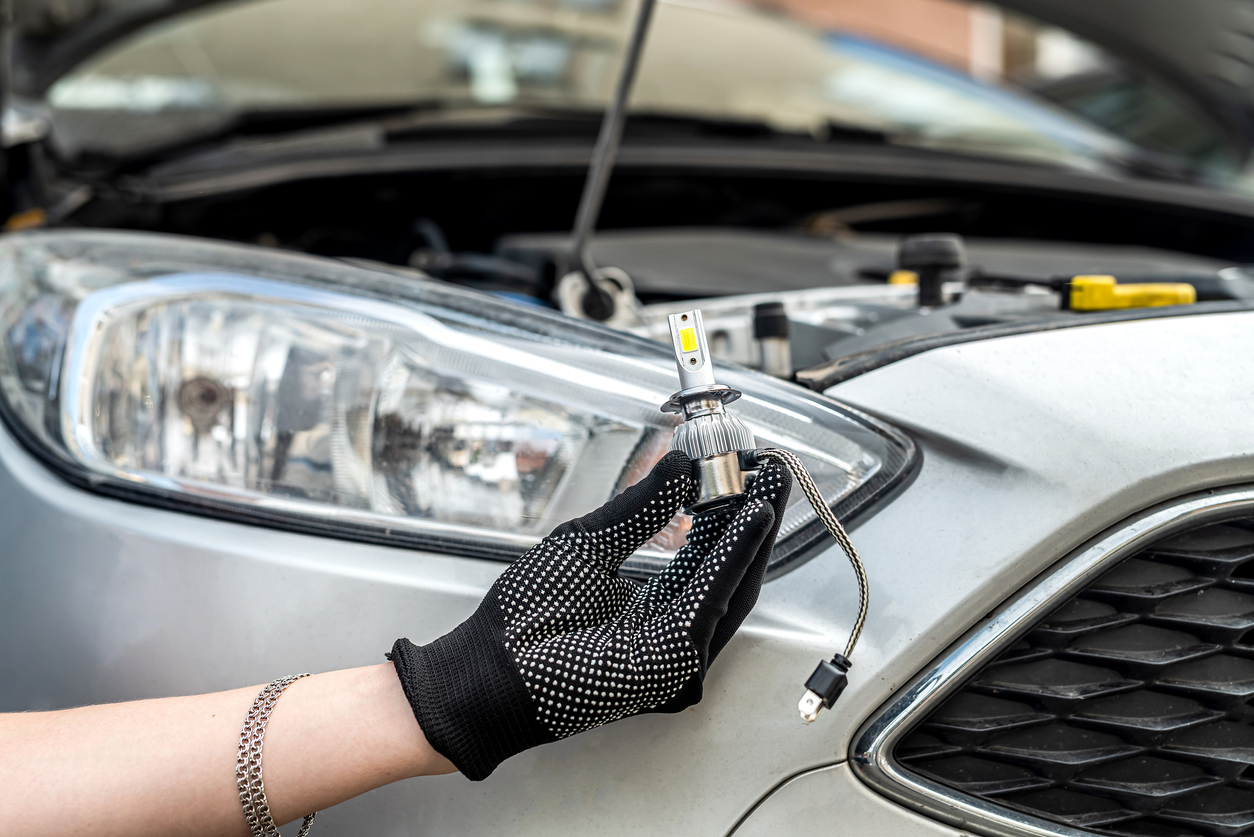
Today is National LED Day! We’re celebrating this handy invention of modern society with a great blog dedicated to a little history lesson followed by recommendations for best LED car lights.

What is an LED and how does it work?
LED stands for Light-emitting diode. An LED is a semiconductor device which emits light when current flows through a microchip, this in turn illuminates the tiny light source. The color of the light emitted is determined by the energy required for electrons to cross the band-gap of the semiconductor. LEDs are different from regular and incandescent light bulbs because they do not have any qire filaments. They’re also incredibly efficient, energy saving lighting options as they produce more brightness for longer, while using less energy and emitting less heat.
Who invented the LED light?
We’ll have to start with the discovery of Electroluminescence, the naturally occurring phenomena upon which all LED tech is built. In 1907, British radio researcher Henry Joseph Round discovered it upon accident when experimenting with silicon carbide and a cat’s whisker. He discovered that a yellow light was produced when current passed through the silicon carbide detector.
Many years later, in 1961, Robert Biard and Gary Pittman invented and patented an infrared LED device for Texas Instruments (which they created by accident while attempting to invent a laser diode instead.) It was the first LED! However, since it was infrared, it was beyond the visible light spectrum for humans.
The first visible LEDs were pioneered by Nick Holonyack, a consulting engineer for GE. Holonyack invented the first visible light LED, which emitted a red hue. In 1972, electrical engineer M George Craford invented the first yellow-colored LED; he also invented a red LED that was 10 times brighter than the one invented by Holonyack. In 1976, Thomas Pearsall invented the high-efficiency, extremely bright LED which is used in fiber optics and fiber telecommunications! In 1995, Shuki Nakamura invented the first blue LED light. The first LED headlights for cars were introduced in 2004, being first employed by Audi followed by Lexus in 2006; now, most vehicles come with LED headlights as a standard option.
As of 2020, Arrow Electronics announced that it has developed a technique that allows for one singular LED to produce each of the three primary colors, allowing tiny LEDs placed in close proximity to render the full spectrum of color!
What are the benefits of LED vehicle headlights?
LED headlights are solid-state bulbs, meaning that they provide much lower operating costs over time, as well as greater longevity to their halogen counterparts. The intensity of the light from the LED is significantly stronger than traditional headlights, creating a whiter, brighter light for more visibility especially in low-light situations. On average, LEDs are 80% efficient, meaning just a mere 20% of their energy is wasted as heat! In addition, the bulbs last an impressive 22 years on average before they fail, and an average of 11 years of continuous driving.
Can I upgrade my older vehicle’s lights to LEDs?
If you’re a real go-getter or an experienced gearhead, it’s certainly worth your while to consider an upgrade. Most vehicles can be retrofitted with LEDs quickly and easily with a special LED headlight kit. If you prefer, you can also reach out to your local trusted mechanic and have them install the upgrade kit for you.
Let’s Go Shopping for some LED Headlights
Fahren H11/H9/H8 LED headlights are affordable and easy to install, making them a great entry level choice for upgrading to LEDs. They have cool white temperature, and deliver 60 watt brightness. Use them as headlights or fog lights depending on the size.
Honcs H11/H8/H9 LED headlights are another budget friendly option on the list. They’re recommended for low-beam use, and have a clear, bright white light at 6000k to 6500k temperature. They’re compatible with a wide range of vehicles, too!
Anzo’s Black LED headlights have a 1 year warranty, and are brighter than the average factory halogen light bulbs. They’re easy to install with plug-and-play wiring, and have a bright, well defined beam for maximum visibility on the road.
Anzo’s Chrome LED headlights have a 1 year limited warranty, require no drilling or cutting or special tools, and are easy to install thanks to their plug-and-play wiring.
![[Facebook]](https://www.classickiaonline.com/blogs/294/wp-content/plugins/bookmarkify/facebook.png)
![[LinkedIn]](https://www.classickiaonline.com/blogs/294/wp-content/plugins/bookmarkify/linkedin.png)
![[Twitter]](https://www.classickiaonline.com/blogs/294/wp-content/plugins/bookmarkify/twitter.png)
![[Yahoo!]](https://www.classickiaonline.com/blogs/294/wp-content/plugins/bookmarkify/yahoo.png)
![[Email]](https://www.classickiaonline.com/blogs/294/wp-content/plugins/bookmarkify/email.png)
Connect with us


- 2026 Kia Sportage Performance and Features for Illinois Drivers
- Top 5 Features of the 2026 Kia Sportage Hybrid
- A First Look at the 2027 Kia Telluride
- Celebrate the Holidays by Gifting a Road Trip to the Michigan Ice Fest 2026!
- Extending the Spirit of The Giving Season: Great Ways to Give Back to the Community For the Holidays (Lake County, Waukegan Area)
Recent Posts
 Warranties include 10-year/100,000-mile powertrain and 5-year/60,000-mile basic. All warranties and roadside assistance are limited. See retailer for warranty details.