


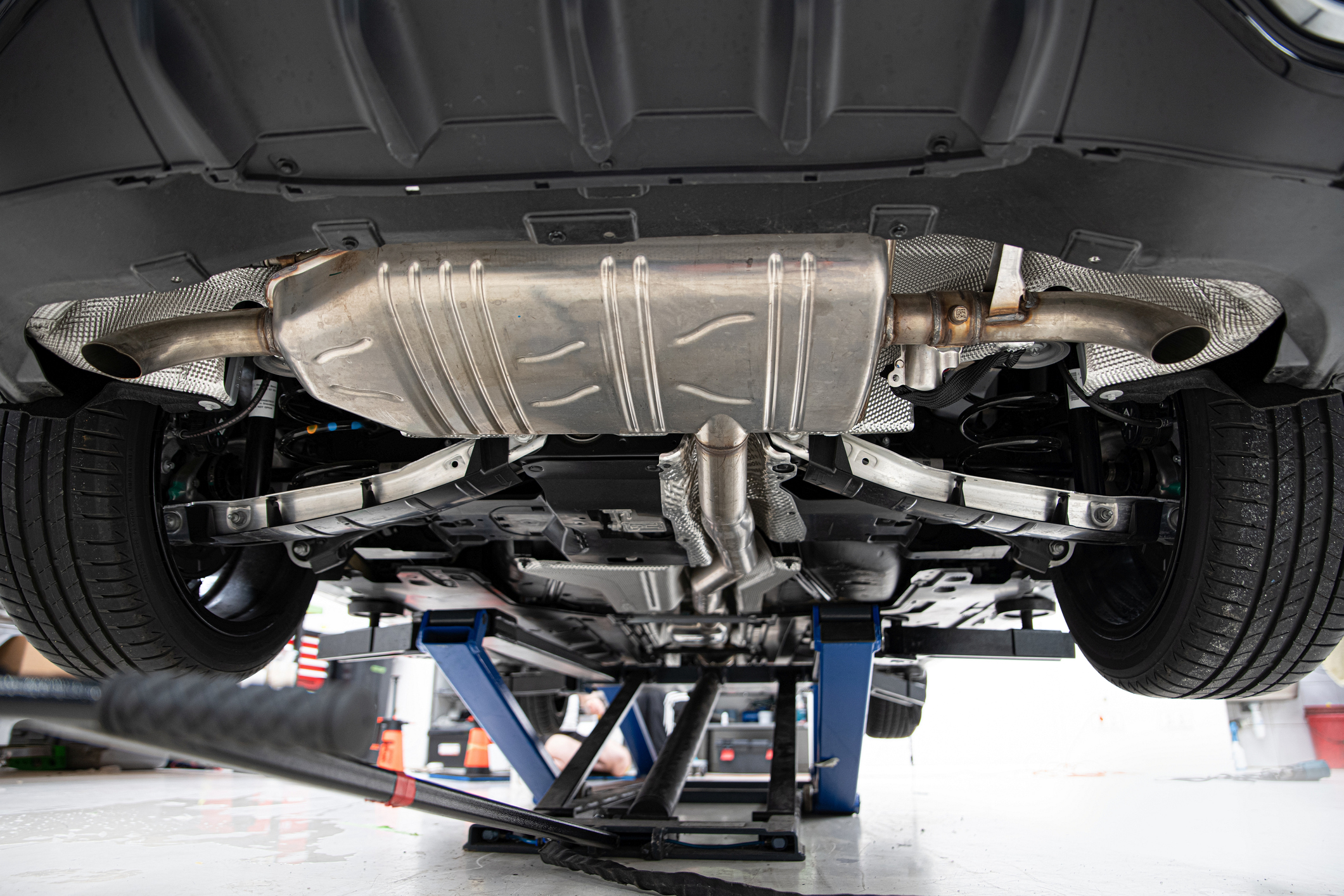
Since buying and fixing cars isn’t a part of our daily or even weekly lives, we know that it might seem a little daunting when you come in to shop or bring your car in for service. We’re hoping our Automotive Terminology series will instill you with a sense of confidence in navigating the industry’s terms and vocab. Today’s topic is the Suspension System.

Let’s break it down! What parts help the suspension system function?
This suspension consists of tires, tire air pressure, coil springs, rods and linkages, joints and bearings and bushings, and shock absorbers or struts. These work together as a system of protective, shock-absorbing components which ensure your car drives safely and smoothly, absorbing bumps and impacts from roadways and other kinetic energy. It supports the vehicle’s weight, absorbs and dampens the shock, and stabilizes the drive to keep it calm and comfortable.
What does the suspension system do?
As you drive, the suspension system’s job is to absorb the energy from potholes, lumps, bumps, cracks, and curbs. Eventually this normal wear and tear will lead to some regular maintenance and repairs. Should the vehicle experience damage from accidents or collision, even minor ones, that additional damage will also have a toll on your suspension and alignment.
If your usual commute has smooth, well-kept roadways your struts and shocks may last longer than average, but you will usually need to replace the shocks/struts at least every 50k and 100k miles. It’s possible that you may need service in between if you have a particularly bad incident, but for the most part this won’t be a repetitive repair.
The suspension system is a vital safety component on your car, and it’s dangerous to drive with worn or broken shock absorbers and increases your risk of accident. If you notice any of these things in your vehicle, call one of our service technicians right away to have it serviced.

When to look for when it’s time to service your vehicle’s suspension system?
Here’s what happens when it’s time to bring your car in for a repair:
- The vehicle begins to drift a bit whenever you turn or drive on a curve.
- you can feel the bumps and shudders as you drive
- It feels as if you’re driving with boulders for wheels
- the vehicle pulls to one side as you drive, especially at higher speeds.
- fluid leaks, oil, or grease accumulation on your shocks/struts.
- tire treads wear unevenly.
- The vehicle frame is sinking a bit.
- unusual noises (a broken strut or shock may have a clinking, clunking, or knocking sound)

Terms your mechanic may use to describe the suspension system:
Adjustable suspension
A suspension that offers driver-selectable damper (and sometimes spring) firmness settings to suit varying conditions and personal preferences.
Auto-leveling suspension
A suspension that adjusts the height of the vehicle so that its rear stays even with the front when cargo is carried; some systems offer multiple height settings for off-road, normal and high-speed operation.
Ball joints
Movable joints in the steering linkage and suspension system of a vehicle that permit rotating movement in any direction between the parts that are joined.
CV joints
Constant velocity joints, which are located on either end of the drive axles and transmit engine power while enabling full steering and suspension movement. Black accordion boots cover and protect these joints and hold lubricant.
Stabilizer bar
Sometimes called an anti-roll or anti-sway bar. A device that connects the left and right sides of a suspension to limit body roll in turn
Suspension fluid
A fluid used in suspension systems that are hydraulically adjustable.
Suspension geometry
The relationship between the placement of the mounting points for each of a vehicles suspension components.
![[Facebook]](https://www.classickiaonline.com/blogs/294/wp-content/plugins/bookmarkify/facebook.png)
![[LinkedIn]](https://www.classickiaonline.com/blogs/294/wp-content/plugins/bookmarkify/linkedin.png)
![[Twitter]](https://www.classickiaonline.com/blogs/294/wp-content/plugins/bookmarkify/twitter.png)
![[Yahoo!]](https://www.classickiaonline.com/blogs/294/wp-content/plugins/bookmarkify/yahoo.png)
![[Email]](https://www.classickiaonline.com/blogs/294/wp-content/plugins/bookmarkify/email.png)
Connect with us


- 2026 Kia Sportage Performance and Features for Illinois Drivers
- Top 5 Features of the 2026 Kia Sportage Hybrid
- A First Look at the 2027 Kia Telluride
- Celebrate the Holidays by Gifting a Road Trip to the Michigan Ice Fest 2026!
- Extending the Spirit of The Giving Season: Great Ways to Give Back to the Community For the Holidays (Lake County, Waukegan Area)
Recent Posts
 Warranties include 10-year/100,000-mile powertrain and 5-year/60,000-mile basic. All warranties and roadside assistance are limited. See retailer for warranty details.